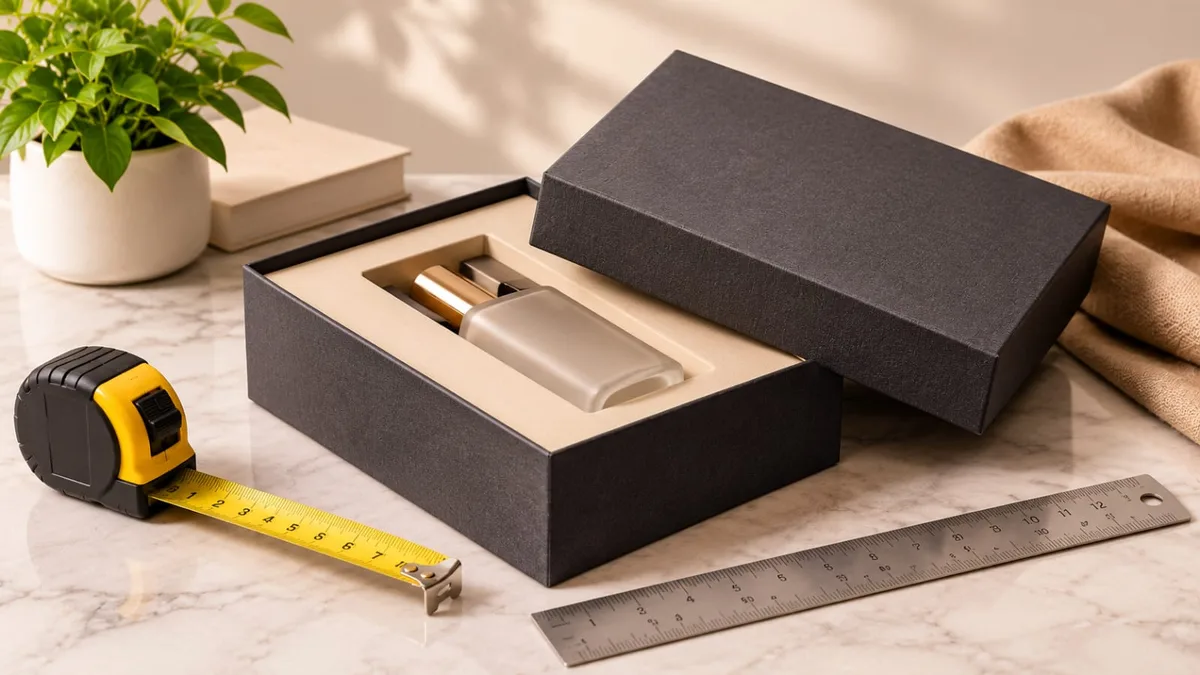
Start with the inside
Fit is decided by the inside of the box, not the outside. Always work from the inside out: the product must fit the inside first; the outside follows from the board and construction. Measure your product first — length, width, and depth — then pick a box whose inside dimensions hold it with a little room for an insert or padding. Dimensions are always written in the same order: Length × Width × Depth.
Lid and base
A rigid box has two main parts: a base that holds the product and a lid that fits over it. In a conventional two-piece rigid box, the lid slides over the outside of the base and overlaps the base walls, so simply adding the two depths can give a misleading measurement. Record the base depth and the lid depth separately, and the final closed-box height is measured on the finished box. The lid must close flat, and the product must sit below the rim of the base. The three parts to know: the lid (covers the top), the base (holds the product), and the insert (holds the product in place inside the base). A shallow lid covers less of the base wall; a deep lid covers more and suits taller products.
Common rigid box sizes
These are sizes you will commonly see for rigid gift and setup boxes. They are examples only, not a stock list — any size can be made to order, and final sizes are confirmed during quoting. Common examples: 3.5 × 3.5 × 2 inches for jewelry and small gifts; 6 × 6 × 3 for small gift sets; 8 × 8 × 4 for medium gifts and cosmetics sets; 10 × 8 × 4 for larger apparel and gift items; 12 × 10 × 5 for large gift sets. If none of these matches your product, that is normal — most brands end up with a custom size.
How to pick your size
Measure the product, then add room for its insert and for lid clearance. The product should sit below the rim of the base so the lid closes flat. A snug fit with a proper insert beats a loose box every time — in a loose box the product slides in transit, and that is how finishes get scuffed. If you are unsure, order a sample and test the fit before committing to a full run.
Size mistakes that cost money
A box that is too large costs more to ship and looks half empty. A box that is too tight risks damage and returns. Right-sizing protects the product and the unboxing experience at the same time.
When none of the standard sizes fit
Share your product dimensions in the quote form and the box is made to your size, lid and base included. If you are not sure yet, tick 'Not sure yet — help me with sizing' in the form — size selection is part of the specification review, and final sizes are confirmed during quoting.
Ready to size your rigid box?
Request a quote with your product dimensions and lid/base preference — or tick 'Not sure yet' and we will help with sizing. If you also use mailer boxes, see our Mailer Box Dimensions Guide.